
 1300 285 885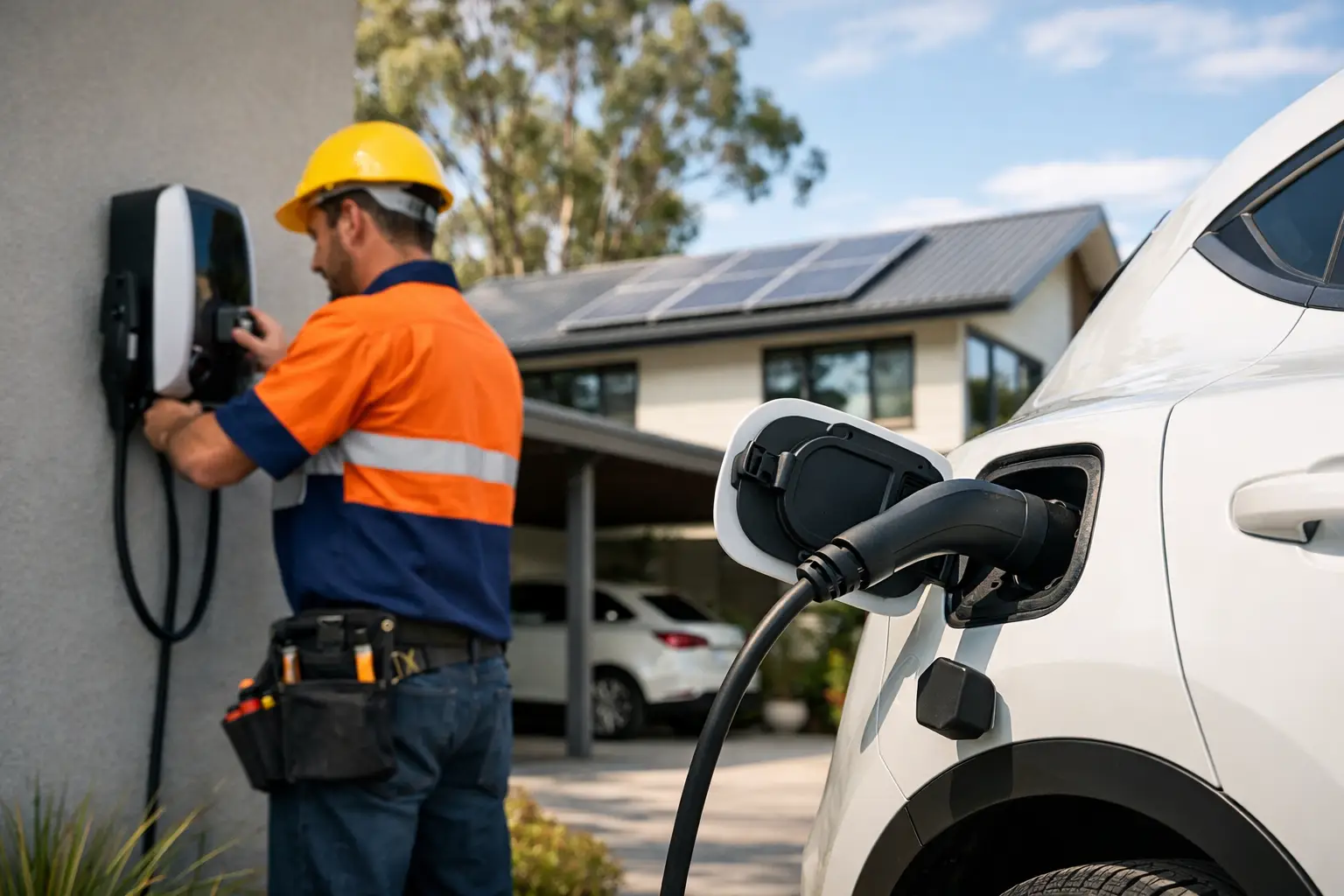
Your new EV may come with a portable charging cable, but relying on a standard power point can be slow and inconvenient. If you are researching how to install EV charger equipment at home, the smart answer is not to treat it as a DIY job. A dedicated home charger gives you faster, safer, more reliable charging – and can help you make better use of solar power during the day.
For most Australian households, the process is straightforward when it is planned properly. The right charger, location, electrical capacity and installer all matter. Get those decisions right first and your EV will be ready when you are, without putting unnecessary strain on your home’s electrical system.
Start with your driving habits and EV battery
Before selecting a charger, consider how far you typically drive and when your car is parked at home. A household that drives short suburban trips and leaves the car in the garage overnight may not need the same charging capacity as a family with two EVs, a long daily commute or a business vehicle that needs to be ready early every morning.
Your EV’s onboard charging capability also affects the best choice. Many home chargers are available as single-phase units, while some properties and compatible vehicles can benefit from three-phase charging. Three-phase charging can replenish an EV battery more quickly, but it depends on your home having three-phase supply, sufficient switchboard capacity and an EV that can accept it.
The goal is to choose a charger that suits your real routine, not simply the biggest unit available. Overnight charging is enough for many homes. If you want to use excess solar generation, scheduled charging and smart load management can be just as valuable as a higher charging rate.
Choose the right home EV charger
A fixed wall-mounted charger is generally the best option for regular charging. It is designed for daily use, connected to a dedicated circuit and installed in a permanent location by a licensed electrician. Look for a quality unit with safety protections, weather resistance where needed, app controls and a strong manufacturer warranty.
Smart charging features are worth considering, especially for homes with solar. Depending on the charger and your wider energy setup, you may be able to schedule charging for off-peak periods, monitor energy use from your mobile and prioritise surplus solar power. That means your car can absorb energy your rooftop solar system produces instead of sending all of it back to the grid.
The cable arrangement matters too. Tethered chargers have a cable permanently attached, making them convenient for everyday use. Socketed chargers allow you to use your own compatible cable and can be a practical choice where more than one EV may charge at the property over time.
Select a practical, safe installation location
Most chargers are installed in a garage, carport or near the driveway. The best location is close enough for the cable to reach the charging port comfortably, without stretching across a walkway, driveway or area where it can be damaged.
Think about where you park naturally. EV charge ports are positioned differently across makes and models, so an ideal location for one car may be awkward for another. Allow enough cable length and choose a mounting position that keeps the unit protected from accidental knocks, water exposure and excessive heat.
If the charger will be outdoors, it needs to be suitable for the conditions. Your installer can advise on mounting height, weather protection, cable management and whether bollards or other physical protection are sensible in a busy driveway or commercial car park.
For apartments, townhouses and rental properties, the first step may be approval rather than electrical work. Strata committees, body corporates, landlords and building managers may have requirements around common property, metering, parking bays and cable routes. Get written approval before installation is booked.
How to install EV charger equipment safely
Installing an EV charger involves more than mounting a box on the wall. A licensed electrician needs to inspect the existing electrical system, determine the available supply capacity and install a dedicated circuit with the appropriate protection devices. The work must meet applicable Australian electrical standards and local network requirements.
A typical installation process looks like this:
- Site assessment: The installer checks your switchboard, supply type, parking area, proposed cable route and the distance between the switchboard and charger.
- System design: They confirm the charger size, dedicated circuit requirements and whether switchboard upgrades, load management or cable protection are needed.
- Electrical installation: The charger is mounted, wiring is run safely, protection devices are installed and the circuit is labelled.
- Testing and commissioning: The electrician tests the installation, confirms the charger communicates correctly with your EV and provides the required electrical documentation.
- App and charging setup: If your charger is smart-enabled, you can connect it to Wi-Fi or mobile data, set schedules and review energy-use settings.
Never use an extension lead as a long-term EV charging solution, and do not attempt to modify a power point or switchboard yourself. EV charging is a sustained electrical load. Professional installation protects your home, vehicle and warranty coverage.
Check your switchboard before installation day
Your switchboard is one of the biggest factors in a smooth EV charger installation. Older homes may have limited room for additional circuit protection or may not have the capacity required to add a charger alongside air conditioning, electric hot water, pool equipment, induction cooking and other major loads.
That does not always mean you need a major upgrade. In some cases, smart load balancing allows the charger to automatically reduce or pause charging when other household demand is high. This helps prevent your main supply from being overloaded while still ensuring your vehicle charges when capacity is available.
Your electrician should assess the whole property load, not just the EV charger. This is particularly important if you are also adding a solar battery, changing to electric appliances or planning a future second EV. Planning for the next few years can avoid unnecessary rework later.
Pair your EV charger with solar
Solar and EV charging are a powerful match for Australian homes. Your panels generate electricity during daylight hours, and a smart charger can be configured to charge your EV when solar production is strong. This can reduce reliance on grid electricity and put more of your solar generation to work.
There is a trade-off. Charging only from surplus solar may take longer on cloudy days or when household consumption is high. Some owners prefer a mixed approach: use solar-first charging during the day, then schedule any remaining charge overnight so the vehicle is ready for the morning.
A battery can add flexibility by storing daytime solar energy for later use, though the right setup depends on your household consumption, vehicle use and energy goals. An experienced solar and EV charging provider can assess how your panels, inverter, battery and charger should work together rather than treating each purchase separately.
Prepare for installation day
Clear access to the switchboard, parking space and proposed cable path before your electrician arrives. If the charger will be installed in a garage, move vehicles, storage boxes and garden equipment out of the work area. The installer may need to access roof space, wall cavities or external areas to run cabling safely.
Have your EV available if possible. Testing with the vehicle is the best way to confirm the charger starts correctly and the cable reaches without tension. Ask the installer to show you how to start and stop a charge, use any app features, understand indicator lights and respond if the charger ever displays a fault.
Keep the compliance documentation and product information in a safe place. These records can be useful for warranty support, future electrical work and property sale discussions.
A charger that fits your energy plan
A home EV charger should make electric driving easier, not create another complicated energy decision. The best installation is one that suits your car, your parking arrangement, your electrical capacity and the way your household uses solar power.
Solar Miner can help homeowners and businesses bring solar, battery storage and EV charging into one practical energy plan. Start with a professional site assessment, choose proven equipment and let a licensed installer handle the work. Then every time you plug in, you can be confident your EV is charging safely and working harder for your energy independence.